
WORK
RECS
ABOUT

Designing a unified parts and labor workflow for repair shops, growing to 600+ net new shops.
INTRO
PartsTech made parts ordering fast, but service advisors still had to leave the product entirely to find labor times.
I designed Service Guides, a vehicle data platform built into PartsTech that unified parts and labor into a single workflow.
The project required designing around unpredictable data structures from multiple API providers, evolving from a constrained MVP to a full-featured reference tool covering labor, maintenance, fluids, and specs.
ROLE
Sole Product Designer
STATUS
Shipped, 2025
TOOLS
Figma
Miro
Useberry
Userpilot
Problems
Business
Without labor support, PartsTech couldn’t capitalize on the opportunity and lost users and revenue.
Users
Shops need complete estimates covering both parts and labor.
Parts-only support forced users to leave the product or manually add labor elsewhere, fragmenting their workflow.
Solution
The original MVP centered on labor estimates by part type.
After gaining access to more partner API data, we broadened the solution to incorporate labor by category, maintenance, vehicle specification, and fluid capacities.
This significantly increased value and usability of the overall product.
Results
Within 10 Months of launch we gained 6 new SMS partnerships that resulted in 600+ net new repair shops on PartsTech and an increase of SaaS revenue.
PROCESS
RESEARCH AND DISCOVERY
We approached discovery from two directions: understanding shop workflows and what partners needed to switch.
Shops
Moderated interviews with service advisors to learn:
How they access labor times and create estimates
About their current solutions
Cold-called shops early on to observe real estimating behavior in the wild
Partners & Internal Stakeholders
Sessions with SMS partners to understand switching criteria
Cross-functional interviews with sales, support, product, and engineering to surface ISE integration pain points
Competitive Analysis
Deep dive into Epicor ISE via documentation, knowledge base, YouTube tutorials, and hands-on exploration. This helped us identify bad UX, and also understand the flows and mental models shops already used.
Analyzed labor patterns across supplier competitors to understand what was technically possible outside the Epicor ecosystem.


DATA CONTRAINTS
Before design began, we hit a data limitation. MOTOR, our labor data provider, could only supply labor times tied to specific part types.
At this time, we did not have access to the functionality required to browse or search labor operations independent of parts. This was a significant hiccup because research taught us that shops' workflow was searching for labor first and then parts.
MVP couldn't fully support that flow.
Rather than wait, we made the call to:
Build around what we had aka labor tied to cart items.
Plan the evolution as a fast follow aka full labor browse
DESIGNS


EARLY DESIGNS
When ideating, the goal is to think out of the box first, then narrow it down.
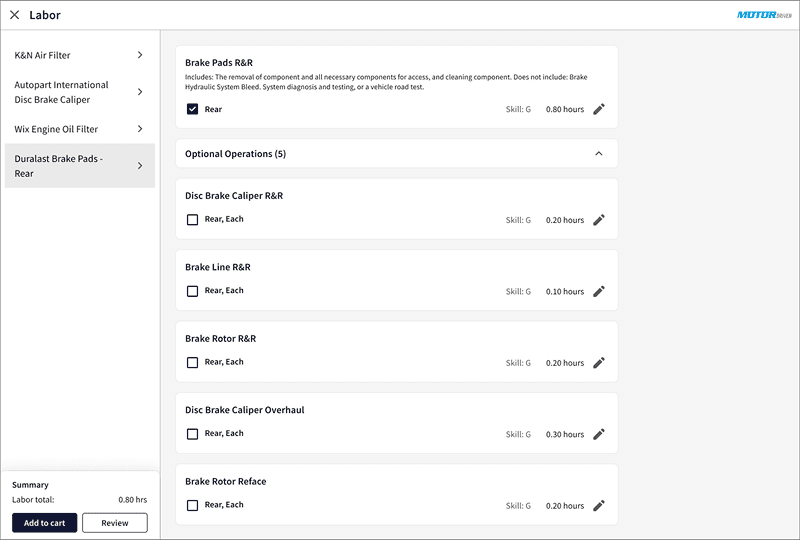
For the initial version, when a shop had parts in their cart, a prompt appeared to add labor.
Clicking it opened a modal displaying MOTOR labor operations tied to those specific parts.
Early usability testing in Useberry focused on discoverability and the ability to add labor to the cart. We also had a handful of customers that helped with the first versions of our product.
DATA COMPLEXITY PROBLEM PT. 2
As we made more API calls and started initial conversations with Mitchell1 about a second data source, the complexity of the labor data set became much clearer. Some parts had dozens of associated labor operations and Mitchell1's data was even more detailed, and more deeply nested than MOTOR's. We decided to fix our labor hierarchy in order to fit avoid information overload and accommodate larger labor sets.
EXPANDING TO SERVICE GUIDES
As our data partnerships matured, MOTOR provided full labor sets and unlocked the labor-first workflow shops needed. We expanded further with maintenance schedules, fluid specs, and vehicle specs, grouping everything under a new product category: Service Guides.
RESULTS
THE FINAL PRODUCT
What launched as a constrained MVP became a full-featured service.
Service Guides became a top-level nav item in PartsTech, a reflection of how central it became to the product for a key segment of users.
Labor: Full browse by job category with search, parts recommendations tied to each operation, and optional vs. primary operations clearly distinguished.
Maintenance: Filterable by mileage, time, and driving conditions
Fluids: Type, capacity, part number, and grade with quick copy for cross-referencing
Specs: Tabular and procedural specs with progressive disclosure and diagrams
OUTCOMES
Within 10 Months of launch we gained 6 new SMS partnerships
EstimateXpress launched its first paying SMS partnership in March 2025.
Within 10 months:
6 new SMS partnerships signed
600+ net new repair shops on the platform
$400K in SaaS ARR generated
Two major partnerships signed for 2026, representing 4,200 additional shops
Projected ARR by end of 2026: $1.1M – $2.5M
REFLECTION
Building a constrained MVP to get business partners on board was the right call
As partners came on, we expanded scope iteratively, shaped by their users' feedback and by data that became available to us over time.
Close collaboration with engineering was truly the key ingredient to this project's success. We pulled datasets together early to understand the structure we were working with, and designed the labor hierarchy around what we actually found, not just assumptions. That back-and-forth was one of the more productive parts of the process.
The bigger friction wasn't internal. Some partners who committed never signed, and others took much longer than expected. But the work wasn't held hostage to that because it was grounded in competitive analysis and discovery interviews from the start.
If I did it again, I'd document as I go. Losing research artifacts mid-project is a real cost for this case study and for whoever picks up the work next.